Floaties, life jackets and survival swimming
ISR's view on flotation devices, where life jackets still belong, and why the child is only one layer of protection.
October 17, 2026 · 3 min read
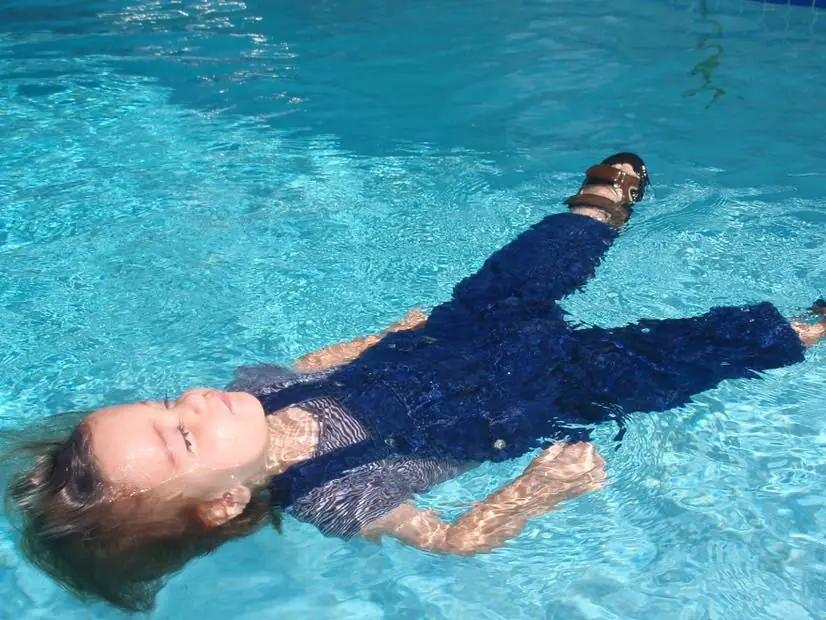
A toddler in arm floaties looks safe. She's upright, her head is out of the water and she's having a great time. ISR's position is that the picture is misleading. This post lays out what Infant Swimming Resource says about flotation devices, what it says about life jackets, and why neither one replaces an adult who is watching.
What ISR says about floaties
From ISR's FAQ: flotation devices give children a false sense of security and hold them in postures that aren't compatible with swimming skills. A child who learns that she can jump in, go vertical and still breathe is, in ISR's words, getting the wrong idea about the environment.
ISR's reasoning is that flotation devices are for children who cannot swim, and that a child who can't swim shouldn't learn it's safe to play in the water while leaning on a crutch. If that's new to you, ask Coach Glare. This is the program she teaches, and she can talk it through with you.
Life jackets are a different thing
Here's the part that gets lost. ISR isn't telling parents to leave the life jacket on the dock. Its FAQ says life jackets must be worn in a boat or around water when there is the potential for an accidental submersion. What they are not, says ISR, is a substitute for the ability to swim or for adult supervision.
So there are two ideas to keep apart. On a boat, wear the life jacket. Around the pool, don't treat a floatie as a babysitter. Equipment has a job, and skills have a job, and ISR's lessons are about the skills.
Layers, not a single fix
ISR describes drowning prevention as multi-layered. Pool fences matter. Supervision matters. Pool alarms matter. And in ISR's view, the child is the most important part of the strategy. That doesn't mean the child carries the weight alone. Gates get left open and attention drifts, and a child with skills has one more thing going for her when the other layers slip.
- A fence around the pool
- An adult who is actually watching, not just somewhere nearby
- A pool alarm
- A life jacket in a boat, or anywhere accidental submersion is possible
- A child who has been taught to roll, float and breathe
No single item on that list is the answer. The point of layers is that each one covers a gap in the others, and no layer is perfect.
Where Coach Glare fits
Glare Sanchez says on her site that her goal is to give moms an additional layer of security by equipping young children with water survival skills that help them stay safe while enjoying the water. The word to notice is additional. The skills are meant to sit on top of fences and supervision, not replace them.
Here's how the lessons work. They're one-on-one, 10 minutes a day, Monday through Friday, for 4 to 6 weeks, for children from 6 months to 6 years. Babies from 6 to 12 months learn to roll onto the back and float. Children from 1 to 6 learn Swim-Float-Swim. Once they're skilled, they practice fully clothed.
For some families the result is as much about the parents as the child. One ISR parent wrote on Glare's site that they can't thank Glare and ISR enough “for the peace of mind that comes when your children are competent in the water.”
A few honest cautions
ISR says its program will greatly increase a child's chance of surviving an aquatic accident. That's ISR's claim, and greatly increase is not the same as guarantee. It's one more reason the other layers stay in place.
ISR is a program for children from 6 months up. If your baby is younger, the layers around the water matter even more, and the swimming skills simply aren't on the table yet, because ISR says children under 6 months are not neurologically mature enough to benefit.
Not every family will land in the same place on floaties. What we'd ask is that you decide knowing what ISR says and why, and that you keep the life jacket on the boat and an adult at the water either way.
And skills fade without care. We cover that in another post, but the short version is that ISR recommends refreshers as a child grows and says that returning to your instructor in a timely way matters.
Questions about floaties, life jackets or whether your child is ready? Call Coach Glare at (321) 662-3718 or sign up online. If registration is closed, ask about the waitlist.
ISR San Antonio, (321) 662-3718
Call (321) 662-3718More articles
Why babies roll to float first
The first survival skill ISR teaches babies from 6 to 12 months isn't swimming at all. It's turning over and breathing.
What a ten-minute ISR lesson looks like
A short daily lesson, a parent on the pool deck and a few fussy first days: what to expect from ISR Self-Rescue in Helotes.