Why babies roll to float first
The first survival skill ISR teaches babies from 6 to 12 months isn't swimming at all. It's turning over and breathing.
October 17, 2026 · 4 min read
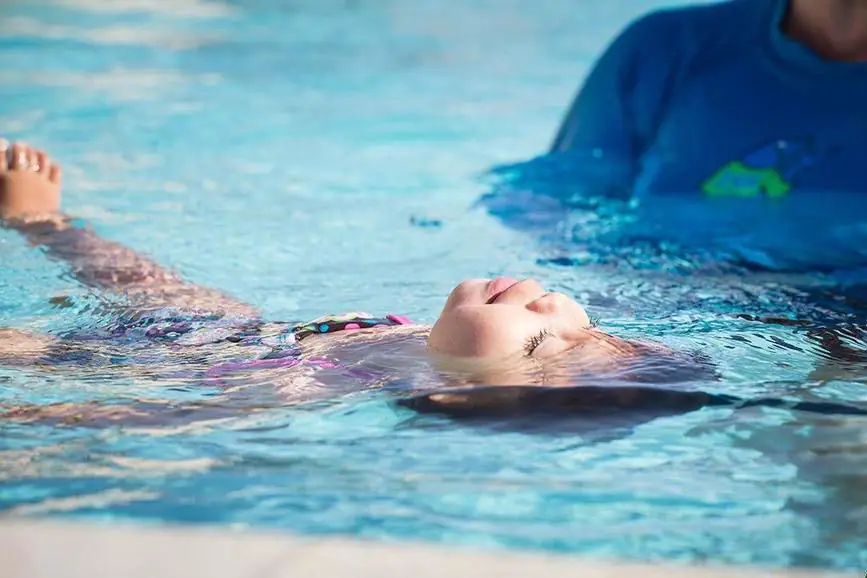
Picture a baby who ends up face down in water. She can't call out. She can't grab the edge of the pool. What she can do, if she's been taught, is turn over and breathe. That one move is the whole point of the first skill ISR teaches, and it's why Coach Glare Sanchez in Helotes starts babies there instead of with anything that looks like swimming.
What Rollback to Float actually is
For babies from 6 to 12 months, Infant Swimming Resource (ISR) teaches a skill it calls Rollback to Float. The baby learns to roll onto her back, float, rest and breathe, and then stay in that position until help arrives. Notice what's missing from that description. There's no kicking, no paddling and no crossing the pool. The job is simply to get the face up and keep it up.
It sounds small. It isn't. A baby who can do this has a way to get air while she waits for someone to reach her. Everything a child learns later, including swimming on her own, is built on top of this first skill.
Why the roll comes before swimming
ISR's answer, from the FAQ on Glare's site, is that a baby doesn't need to understand danger to respond well. In ISR's words, if a baby has learned to roll over and float when he needs air, he doesn't have to perceive danger to respond that way. What he needs is skill, practice and confidence to calmly deal with the situation.
That's worth hearing as a parent, because it explains the whole approach. Nobody is trying to teach a nine month old to be afraid of the water, and nobody is asking her to understand anything. She's learning one repeatable thing her body does when her face is in the water: turn, float, breathe.
Once a baby can do it calmly, she can do it again the next time. Practice is how it becomes a habit, and practice is what the daily lessons are for.
What it looks like from the edge
Parents don't get in the water during ISR lessons, so you'll watch from the side while Coach Glare works one-on-one with your baby. Lessons are 10 minutes a day, Monday through Friday, over roughly 4 to 6 weeks. Your baby may fuss at first. ISR's FAQ says that's common in the first few lessons, because the pool is a new place with new people, and that the fussing decreases as a child grows more confident in the water.
- Rolling from face down onto the back
- Floating on the back with the face up
- Resting and breathing while floating
- Staying in that float until help arrives
Those four things are the skill set for the 6 to 12 month group. Each lesson is short, and each one is a chance to practice them again.
Why ISR doesn't teach under 6 months
Parents often ask whether earlier is better. ISR's position is that children under 6 months are not neurologically mature enough to benefit from ISR instruction, and that's why Glare starts at 6 months. It isn't a rule she made up to be careful. It's the national program's line, and she teaches within it.
If your baby is younger than 6 months, there's nothing to do yet except plan ahead. Once your baby reaches 6 months, you can sign up. If registration is closed or no slots are open, you can join the waitlist and you'll be contacted by email or text when a slot opens.
A skill that grows with the child
Rollback to Float is the first step in a sequence. Between ages 1 and 6, ISR teaches Swim-Float-Swim, where a child swims with her head down, rolls onto her back to float and breathe, then rolls over again to keep swimming. We walk through that in a separate post. The thing to take from this one is that the floating roll is the foundation, not a warm-up.
Glare's own path to this work started with her son. She grew up in Puerto Rico, where she says learning to swim young is imperative for islanders, and she trained as an engineer. She left her job to stay home when her son was born, first experienced ISR with him when he was one, and later became a certified ISR instructor. Her stated goal is to give moms an additional layer of security by equipping young children with water survival skills.
If you have a baby between 6 and 12 months and want to talk it through, call Coach Glare at (321) 662-3718 or sign up online through the ISR San Antonio site. If the current season is full, ask about the waitlist.
ISR San Antonio, (321) 662-3718
Call (321) 662-3718More articles
What a ten-minute ISR lesson looks like
A short daily lesson, a parent on the pool deck and a few fussy first days: what to expect from ISR Self-Rescue in Helotes.
Swim-Float-Swim explained for parents
How ISR teaches children from 1 to 6 years to swim, roll to float, rest and swim again, one step at a time.